Welcome to Scotland’s Border Abbeys, a unique concentration of medieval ruins which share a broad affinity of origin and denouement.

Overview of the Border Abbeys
Ruins of the four abbeys are located in close proximity, in a triangle situated about 40 miles (65 km) SSE of Edinburgh. This area is part of the Scottish Borders region. The abbeys can be found at Melrose, Jedburgh, Dryburgh and Kelso.
All of the abbeys were founded in the 12th century under the patronage of Scotland’s King David I. They each suffered extensive physical damage by English armies during the Wars of Independence and other conflicts. Life of the abbeys came to an end as Catholic religious establishments at time of the Reformation in 1560. All are now romantic ruins and popular visitor attractions.
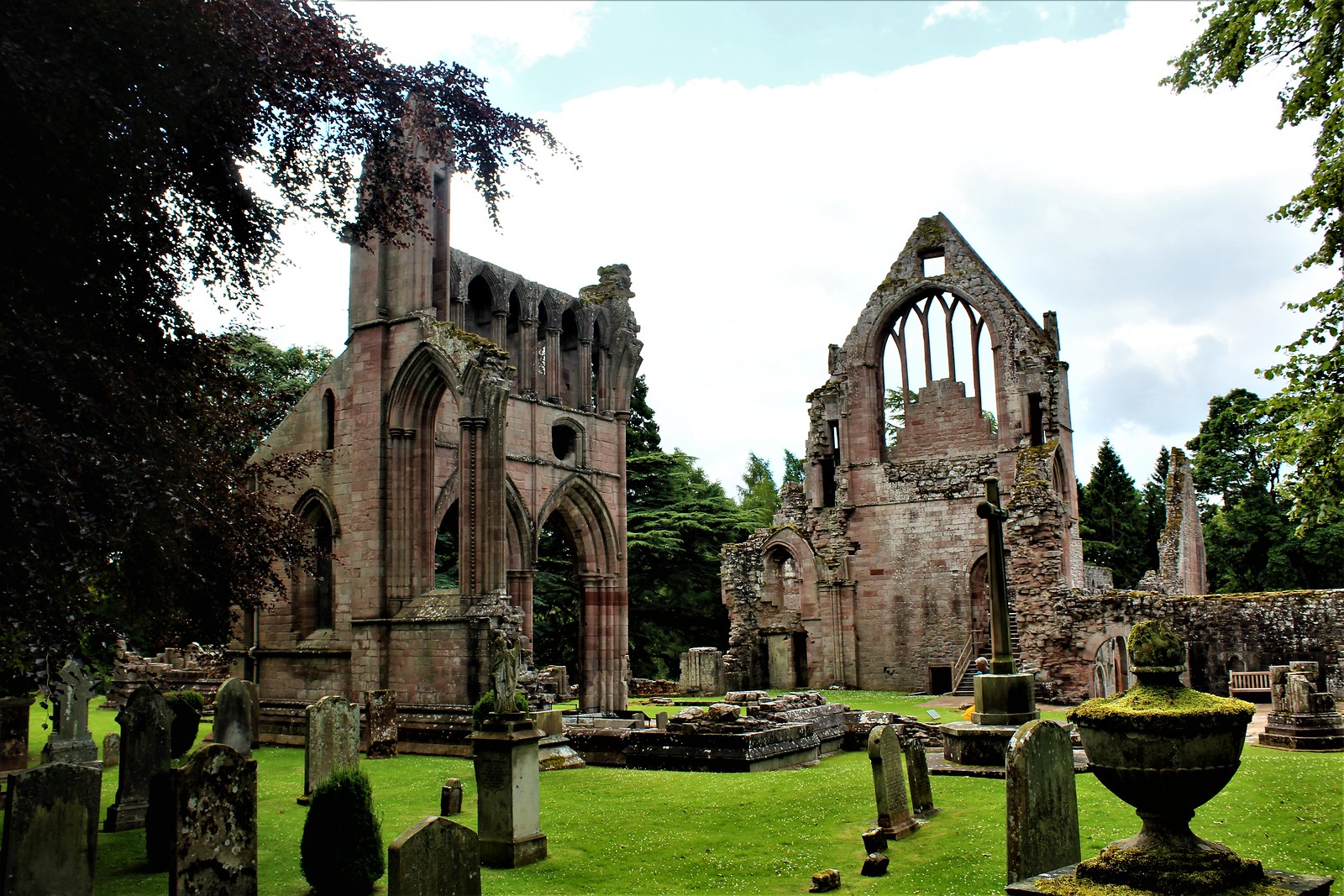
Dryburgh Abbey
Founded in 1150 by Hugh de Morville, an Anglo-Norman for a cadre of Premonstratensians who were community based priests, not monks. Location on the route of invading English armies left the Abbey vulnerable to attack with major damage occurring in 1322, 1385 and 1544. The latter event was a wholesale destruction by the army of the Earl of Hertford. Monastic life ended with the Scottish Reformation in 1560.
Dryburgh Abbey never reached the standing and power of its neighbours, in part due to indiscipline and drift during the 14th and 15th centuries.
The ruins comprise: Abbey Church, Cloister Buildings, Dormitory, Chapter House. Warming House and South Range.
Buried within the grounds are the remains of Sir Walter Scott of Abbotsford and Field Marshal Earl Haig.
Dryburgh Abbey enjoys a particular serene and picturesque location on a loop in the River Tweed.
→
Jedburgh Abbey
This abbey was founded in 1138 by King David I for an Augustinian order.
Construction may have taken 100 years with result being some of the finest Romanesque and Gothic architecture in Scotland.
Jedburgh Abbey suffered damage at the hands of English armies in 1464, 1523, 1544 and 1545. Monastic life ended in 1560 as a consequence of the Reformation.
Most of the Abbey buildings have been reduced to their foundations. However, the site is dominated by the, largely intact, Abbey Church which features very high quality stone work as represented in the Gothic style nave and Romanesque eastern end.

The Abbey is located close to the Jed Water (river) which would have been the main source of water for the monks.
Many travellers in the Scottish Borders region pass this impressive site due to proximity of the A68 highway.
Kelso Abbey
Kelso Abbey was founded in 1128 for a community of Tironensian monks. Patrons were King Alexander I and his brother, King David I.
This Abbey became very rich and powerful with an extensive library. Here was crowned James III and James IV. Prince Henry, son of David I, is buried here.
The abbey was constructed in the Romanesque style with the Abbey Church featuring two towers and four transepts.
Kelso Abbey became a focus of English military attacks which occurred in the 14th century (Wars of Independence), 1523, 1542, 1544 and 1545. The latter resulted in almost complete destruction under the Earl of Hertford’s army.
The only physical remains today are those comprising the West Tower and part of the Infirmary.
Located in the centre of Kelso and close to the River Teviot.

Melrose Abbey
Melrose Abbey was completed around 1146 for a community of Cistercian monks under the patronage of King David I. This Gothic style structure replaced an earlier monastery of the Celtic Church which was located about two miles distant.
The Abbey suffered damage by English troops in 1322 and 1385, acts which prompted extensive rebuilding in the 15th century. However, the English attacked again in 1544 causing further extensive damage which was never fully repaired. Catholic worship finished at the site as a function of the Reformation in 1560.
This Abbey is connected with two major Scottish personages: King Robert the Bruce (1274-1329), whose heart was buried in the grounds and Sir Walter Scott (1771-1832), who had an affection for the building and made reference to it in his poem ‘Lay of the Last Minstrel’.
The Abbey was built in the form of a St. John’s Cross and is noted for the quality of the stone carvings which include an unusual effigy of a pig playing the bagpipes.
Much of the structure remains intact including the tower. Visitors are allowed to climb the latter and benefit from the views over the surrounding landscape.


As a romantic an attractive ruin, Melrose Abbey ranks as one of the top visitor attractions in the Scottish Borders.
More information on Scotland’s Border Abbeys
For more information on the Border Abbeys and other aspects of Scotland refer Visitors Guide to Scotland, ISBN 978-1-9161332-0-4