Introduction
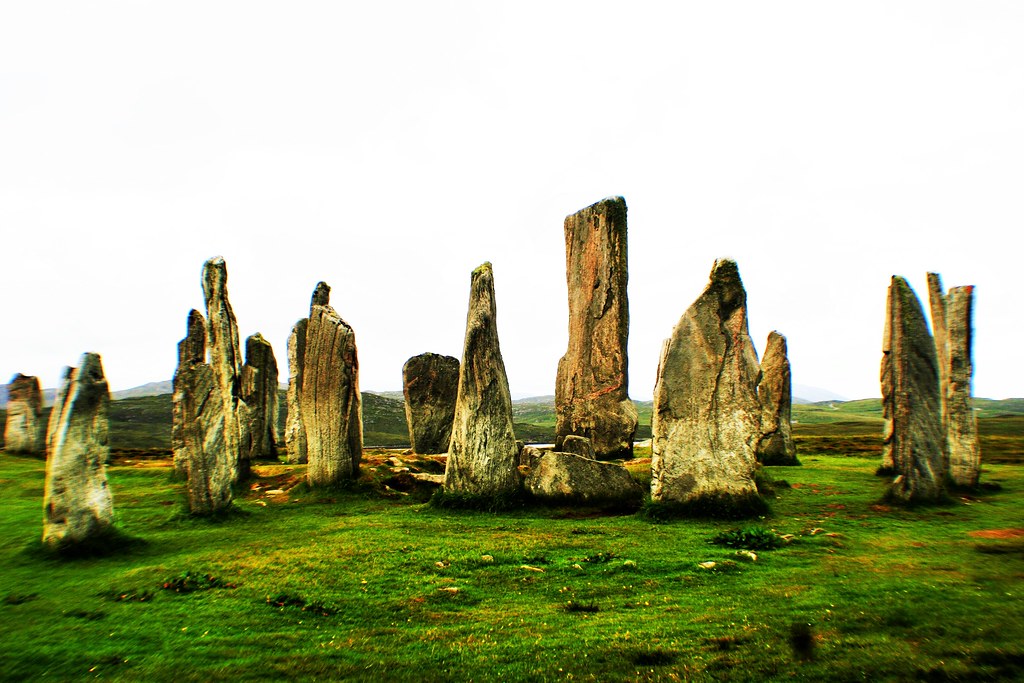
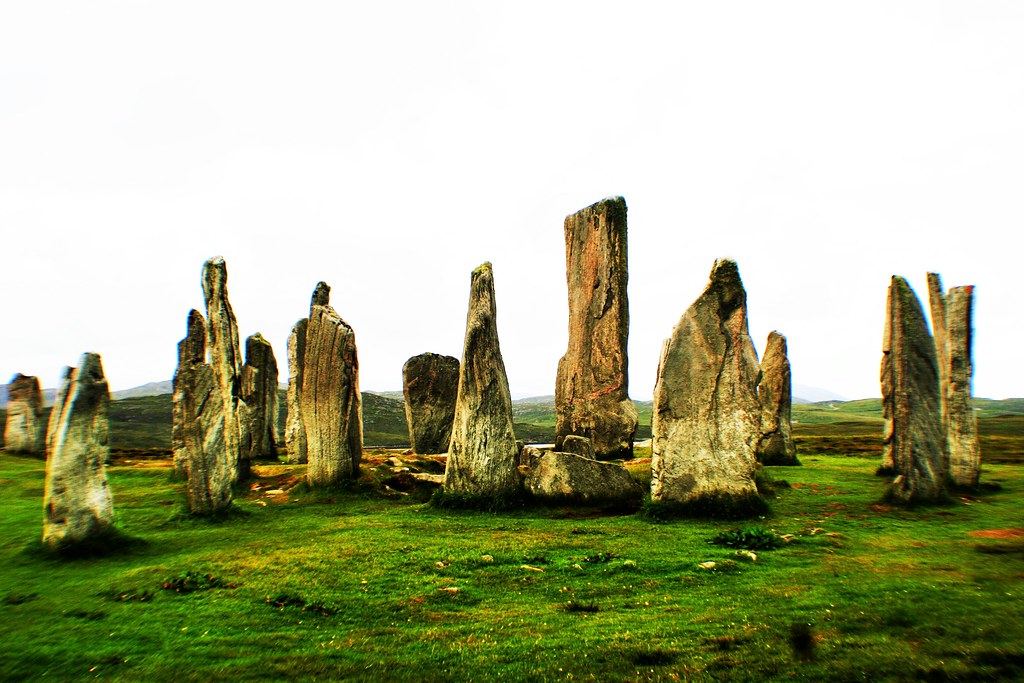
The Callanish Standing Stone Monument (Callanish I) is one of Scotland’s (and Western Europe’s) top ranked prehistoric monuments. In fact, this is one of four such monuments/circles all of which are located in close proximity. The nearest community is Coirean an Fhuarain on the west coast of the Isle of Lewis in the Outer Hebrides.

This prominent site is located some 13 miles west of Stornoway (capital of Lewis).
The name Callanish (or Calanais) is derived from ‘Cala’, a personal name which is found elsewhere on Lewis.
Information on the Callanish Standing Stone Monument
The monument was probably built over several phases, not as a single project.
The stone circle is actually an ellipse.
Callanish I is just one of a concentration of stone circles in this particular locality. Similar concentrations can be found in other parts of Scotland: Kilmartin Glen in Argyll and Machrie Moor on the Isle of Arran.
Comprises a diminutive stone circle, a central stone, an avenue, three rows and a chambered tomb. The latter is of unusual design with nearest likeness found on South Ronaldsay in the Orkneys off Scotland’s north coast.

- Although the site impresses for its grandeur and astronomy, the ring is of modest proportions, with an internal area of just 1334 sq ft or 124 sq m.
- The central line of the stone avenue is aligned on the setting of the southern moon.
- The site may date from 2200 BC.
- After falling out of use the site was subject to an accretion of peat. It was not until the removal of a 5 ft ( 1.5m) deep layer of the peat material in 1857 that the extent of the site became evident. Interestingly, stone circle building ceased around 1000 BC, a time which coincided with climate change which in turn triggered accumulations of peat which in turn protected the site over a period of some 3000 years.
Video clip of Callanish site
Visiting Callanish
The Isle of Lewis can be reached by ferry from any of Ullapool, Uig (Isle of Skye) and Oban. Alternatively, flights are available to Stornoway from Glasgow.
More information
For more information on Scotland’s prehistory and sightseeing in Scotland please refer Visitors’ Guide to Scotland, ISBN 978-1-9161332-0-4