

Introduction
Linlithgow has a population of about 19,000 and is located about nineteen miles west of Edinburgh in eastern Scotland.
The name is of Brittonic (Welsh) origin being derived from llyn llaith cau or ‘wet hollow lake’.
Although a historic town with much to offer, Linlithgow is usually by-passed by most tourists due to focus on other priority sites. However, the Palace has featured in Outlander and consequently attracts persons wishing to connect with scenes in that T.V series.

Palace
- A luxury, lake-side residence for Scotland’s ruling Stuart dynasty.
- This was the birthplace of Mary, Queen of Scots.
- Construction lasted 100 years, spanning 15th-17th centuries
- After King James VI relocated to London in1603 the building fell into decline.
- Oliver Cromwell wintered at the Palace during 1650-51.
- ‘Bonnie’ Prince Charlie stayed at the Palace in 1745. In January of the following year troops of his adversary, General Cumberland occupied the Palace after which it suffered severe fire damage. Today, the structure remains much in the same condition as February 1746.
- Architecture was influenced by the Renaissance style.


St Michael’s Church
- This building is located on an ancient Christian site but re-built between 1426 and 1531 owing to fire damage of predecessor.
- Situated adjacent to Linlithgow Palace.
- Mary, Queen of Scots was probably baptised here in 1542.
- Alters and statues were destroyed/removed after the Reformation in 1560.
- During plague epidemics in Edinburgh, the church was used for classes by Edinburgh University.
- During the 17th century the church was used as a timber store by Linlithgow Town Council.
- Closed for restoration between 1896 and 1898.
- In 1964 the crown was fixed atop the church tower. This replaced an earlier stone cross and is intended to represent the Crown of Thorns.

Spectacular stained glass window. This dates from 1992 and was created to commemorate the 750th anniversary of the church’s consecration.

Statue of Mary, Queen of Scots

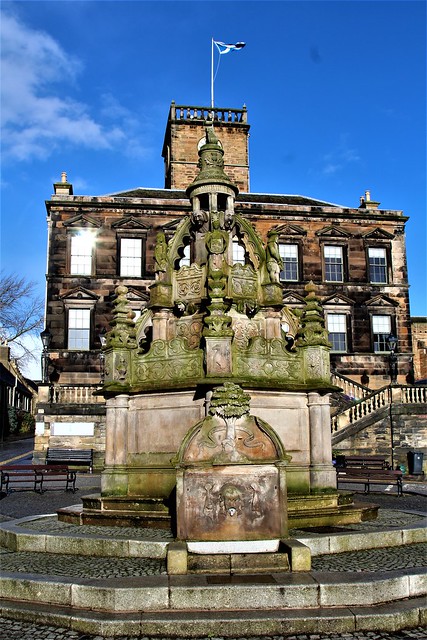
Canal Centre
The Union Canal runs from Falkirk to Edinburgh. This was constructed to bring minerals, especially coal, to Scotland’s capital and was opened in 1822. The project was initially successful, but the construction of railways, particularly the Edinburgh and Glasgow Railway, which opened in 1842, diminished its value as a transport medium. The canal fell into slow, commercial decline and was closed to commercial traffic in 1933. It was officially closed in 1965 but re-opened in 2001 and now used for leisure activities.
The Canal Centre (illustrated) is run by a not-for-profit society which operates a canal museum, tea room and boat trips.


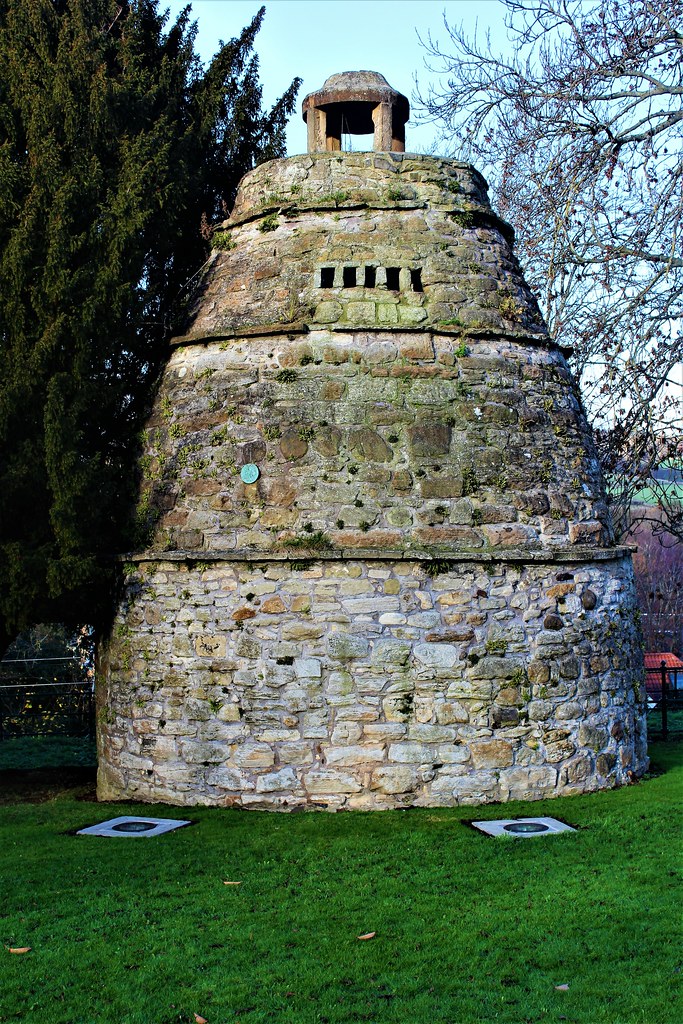
Dovecot (or Doocot)
Dates from 16th century at which time pigeons were an important food source.



Battle of Linlithgow Bridge
The Battle of Linlithgow Bridge took place near Linlithgow on September 4th 1526, close to the River Avon.

Despite the heavy casualties on the day the actual battle site is partly built over and is not commemorated or marked.
The cause of the battle was an attempt by the mother of the young King James V, Queen Margaret, to release her son from the clutches of self-appointed guardian, Archibald Douglas.This was at time of a power vacuum following the death of James IV at the Battle of Flodden, in 1513.
The Queen had a nominally superior force of 10,000 men under the Earl of Lennox vs 2500 under the Earl of Arran. However, the larger force became trapped between the marshy ground close to the River Avon and the nearby high ground occupied by Arran’s force.Lennox’s position was exacerbated by arrival of reinforcements totalling 3000 men from Edinburgh. Outcome was defeat for the Queen’s force with at least 3000 dead including Lennox.
More information
For more information on Scotland’s history and heritage including wide ranging information for tourists please refer Visitors’ Guide to Scotland, ISBN 978-1-9161332-0-4.