Introduction

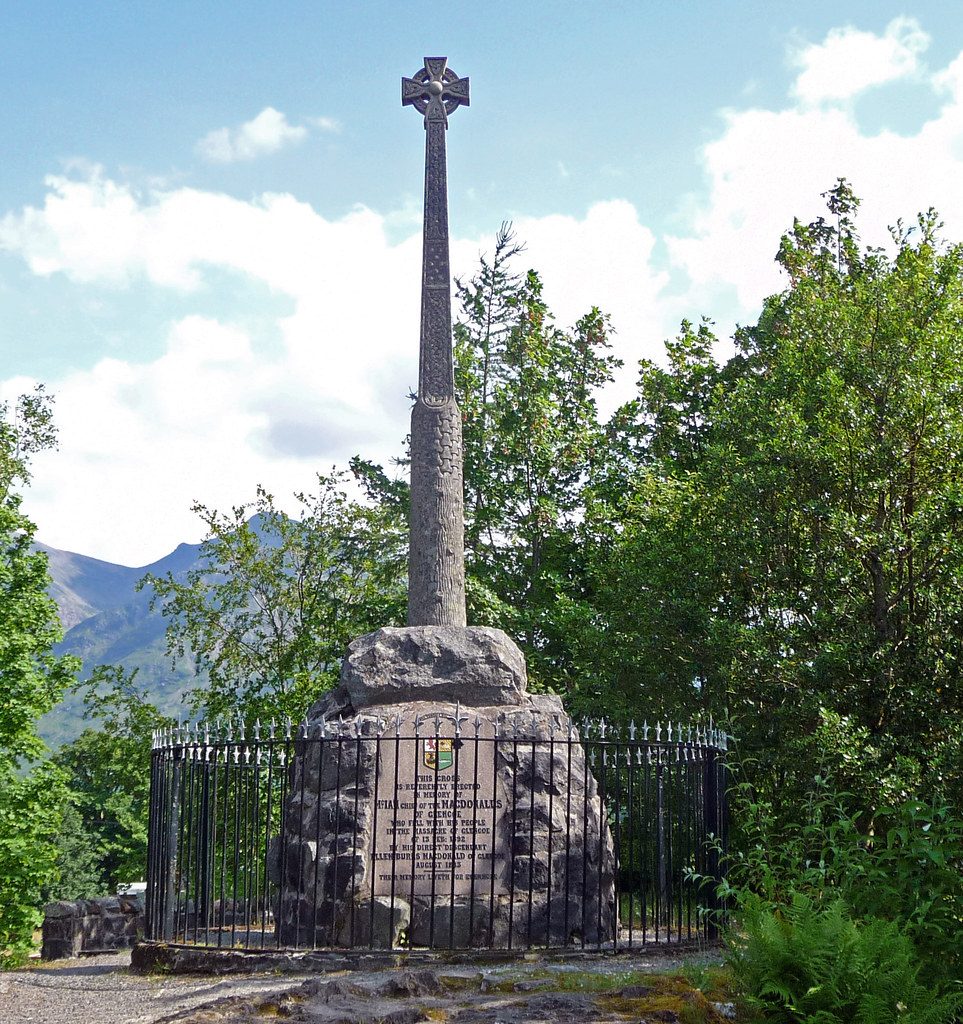
Glencoe (valley of the River Coe) is an extensive, rugged, scenic landscape environment which includes the village of same name. The village is located sixteen miles south of Fort William in the Scottish Highlands. It was in this locale that the infamous Massacre of Glencoe took place.

Today, the region is popular with outdoor enthusiasts who pursue such activities as hiking, climbing and skiing. However, the pleasures of today are offset by a sinister historic event which culminated in the government ordered murders of around 38 locals in 1692. This massacre still resonates in the local conciousness today.

Background to the Massacre- Tranche 1
In common with many events in Scottish history, religion was the key driver.
Apart from gaps during the English civil war, for most of the 17th century Scottish (Stuart dynasty) kings held the thrones of England, Scotland and Ireland. Technically, Scotland was independent with its own parliament but in practice was ruled by the King from London.
By 1685 it was becoming apparent that King James VII (Scotland)/King James II (England) was increasingly demonstrating Roman Catholic leanings including the divine right of kings to rule. This was at a time when both England and Scotland had renounced catholicism in favour of variants of the protestant religion.
Tensions began to build resulting in establishment figures extending an invitation to William III, Prince of Orange in the Netherlands to invade England and assumes the thrones. Both William and his wife Mary were protestants.
The Williamite invasion was uncontested and James went into exile. This event (1688-9) is known as the ‘Glorious Revolution’.
Although the exiled James was in France he plotted a return to power in Britain. This cause resulted in numerous ‘Jacobite’ uprisings between 1689 and 1746. (‘Jacobus’ is the Latin term for James.)
Coinciding with the events described above, the Highland clans were split into two distinct groups. Firstly, Protestants (Presbyterians) who supported William in context of an Anglo-Scottish union and secondly those who were Catholic (or Episcopalian) who supported the Stuart dynasty and Scottish independence.These divisions were manifested in two of the largest clans, namely Campbells (Williamites) and MacDonalds (Stuarts).
Background to the Massacre- Tranche 2
By 1690 tensions were rising. By this time there had been three, Jacobite inspired military conflicts: Killiecrankie, Dunkeld and Cromdale. To ease the tensions, King William sent John Campbell (Lord Treasurer of Scotland) to parley with recalcitrant clan chiefs. He offered of bribes and pardons on condition they all signed an Oath of Allegiance to William by January 1st 1692.
In October 1691 the Jacobite supporting clan chiefs contacted the exiled James for permission to sign the required Oath. Whilst approval from James was eventually granted such did not arrive until December 23rd and was not widely shared until December 28th. This was just three days short of the deadline.
At this time the MacDonalds of Glencoe, a minor branch of the mighty clan, were headed by Alasdair who set off on December 30th 1691 to swear allegiance. He first went to nearby Fort William, which at that time was a government military base. However, the Governor at Fort William denied he had the requisite authority to accept the Oath. Instead, Alasdair was directed to the Sheriff at Inveraray, about 72 miles to the south, in the middle of winter.

Because the Sheriff was not immediately available signing of the oath was delayed until January 6th 1692.
The Massacre
By way of further background, the MacDonalds were renowned in the Highlands for thieving and lawlessness. This seemed to be a time for settling of old scores. On January 7th, Lord Stair (Joint Secretary of State in Scotland) announced that all those who missed the deadline were to be punished.
On February 1st around 120 troops of the Earl of Argyle’s Regiment of Foot led by captain Robert Campbell imposed themselves on the MacDonald community at Glencoe. The military came with orders demanding free food and lodgings. Note that this military unit was comprised of Campbells, historic rivals of the MacDonalds.
On the morning of February 13th the military guests broke the code of Highland hospitality and, under orders from the king, embarked on a killing spree. This resulted in the deaths of about thirty eight clan members. It is believed that many clan members escaped into the freezing landscape and died of hypothermia and/or starvation. The overall death toll may have been around 90 persons.


Outcome of the Massacre
The slaughter proved counter-productive. Lord Stair was forced to resign whilst the wider Clan MacDonald were galvanised into supporting the Jacobites through to their final defeat at Culloden in 1746.

More information
The publication entitled A Visitors’ Guide to Scotland provides more information on Scottish battles, Glencoe and general sightseeing throughout the country. ISBN is 978-1-9161332-0-4
Acknowledgement: Some of the information in this article was sourced from Scotland Magazine.