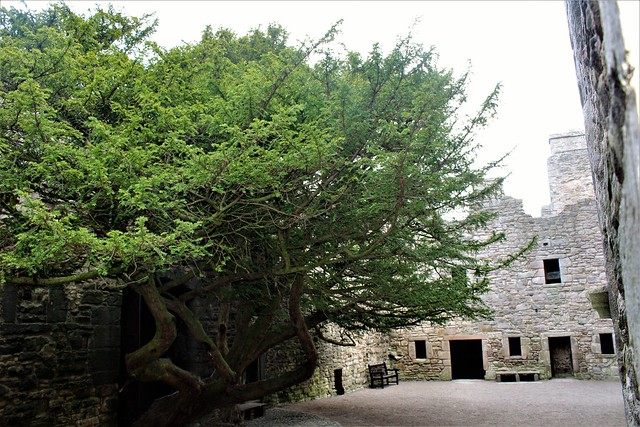
North facing wall between inner and outer courts.

Introduction
Craigmillar Castle lies about four miles south of the city of Edinburgh, Scotland.
Like many other British castles, Craigmillar evolved over many hundreds of years. It was, at first, as a free-standing Tower House, probably in the 14th century by Sir Simon Preston. The de Prestons derived their surname from their estate at Preston in East Lothian which is nearby. For the first 250 years of its existence, Craigmillar was the property of the Preston family. In 1660 it was acquired by Sir John Gilmour and was eventually abandoned (by the Gilmours) in the late 18th century. Craigmillar’s most famous guest was Mary, Queen of Scots who visited in 1563 and again in 1566-7.
Mary Queen of Scots connection

The combination of the castle’s elevation and distance from Edinburgh served to make Craigmillar a convenient retreat on both health and personal security grounds.
In 1566 Mary ordered a refurbishment of the castle following the murder of her secretary, Rizzio. She remained at the castle during the winter of 1566-67.
On 10 February 1567 Mary’s husband, Darnley was killed in Edinburgh as a result of plotting by nobles at Craigmillar Castle.
The neighbourhood below the castle is still called ‘Little France’ in recognition of the time during Mary’s stay, 1566-67 when her French courtiers and servants were billeted in the village.
Military function
During the medieval period Craigmillar was a key link in the chain of fortifications which defended Edinburgh. The castle was in line of sight of Edinburgh Castle thus facilitating communications between the two via flashing mirrors and/or beacon braziers.
Key aspects of the castle
- The Tower House
- The Laird’s Hall
- ‘Queen Mary’s Room’
- The East Range
- The West Range
- Courtyards and Gardens including a P shaped fish pond.


Filming
Craigmillar Castle features in Outlaw King and Outlander.
Visiting
Buses are available from North Bridge, Edinburgh and Elm Row, Edinburgh.
Check castle website for opening times, etc.
More information
For more information on Scottish castles, Mary, Queen of Scots, aspects of Scottish history and touring Scotland please refer Visitors’ Guide to Scotland, ISBN 978-1-9161332-0-4