Introduction
This evening, I am posting images and information on the quaint village of Fortingall. Location is central Scotland, about eighty-three miles north of Edinburgh.
Fortingall: Key facts and information

- This is an ancient settlement. History dates back to at around AD 600 when an early Christian community was established, possibly a monastery within the Celtic Church. Around AD 1100 the monastery was replaced by a succession of conventional churches. Originally Catholic, the local church is now Presbyterian within the Church of Scotland. An ancient stone font is outside the church, together with interesting cross marked slabs, while inside are fragments of fine Pictish crosses.
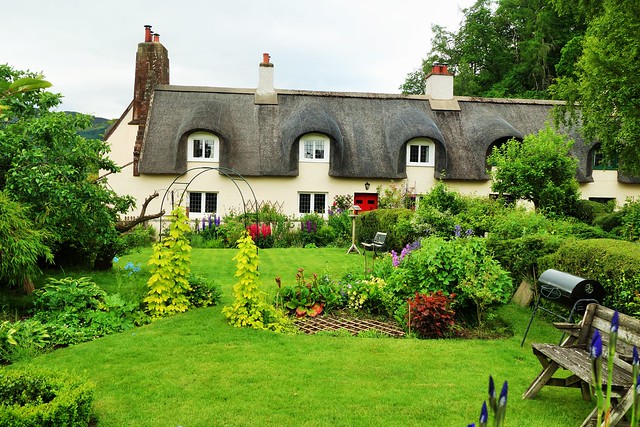
- Rebuilding of the village occurred under the sponsorship of businessman, Sir Donald Currie commencing in the 1890s.This was undertaken in the Arts & Crafts style and continued through to 1936. The rebuild project included the village hall (community centre) and hotel. Note the high incidence of attractive thatched houses.
- The village is strategically located at junction of the rivers Tay and Lyon.
- The name translates as ‘Fortress Church’, being a mix of Brittonic (Welsh) and Gaelic languages.
- The churchyard contains a majestic yew tree which is thought to be between 3,000 – 5,000 years old. However, the tree’s life span may have been reduced due to tourists cutting off parts as souvenirs and causing stress. (In Britain, yews are common in churchyards. This feature may date back to pre-Christian times when yews were revered for their longevity and association with everlasting life.)
- Fortingall is usually encountered in course of a tour of Glen Lyon, which is a delightful ‘backroads’ route. The village is within range (one day motor tour) of Dunkeld, Aberfeldy, Pitlochry and Killin
- In a field close to the village is a prominent earthwork of medieval origin.Nearby prehistoric stranding stones suggests the area has been occupied by man for around 5000 years.


More information.
For more information on central Scotland, many aspects of Scotland’s history and touring the country please refer Visitors’ Guide to Scotland, ISBN 978-1-9161332-0-4