Introduction
This evening, I am providing a summary of Glasgow and the tobacco industry. The industry was closely linked to slavery the leading participants of which are currently subject to critical scrutiny.
As explained below, the tobacco boom led to bust. However, thereafter Glasgow re-grouped and moved on to greater prosperity as a leader in the Industrial Revolution.
Overview
At the start of the 18th century Glasgow was a poor town on the fringes of Europe. However, by the end of the century the city had become the second city of a powerful empire.
Colonial trade drove the transformation of Glasgow between 1740 and 1775. Above all, the trade in tobacco made much of the Glasgow we see today. This trade was inextricably linked with slavery and the slave trade. Glasgow found it’s niche by directly supplying the American colonies with essential manufactured goods, linen cloth and iron.The ships returned to Britain with colonial goods, mainly tobacco from mainland Maryland and Virginia. Additionally, sugar and other exotic products of slavery from the Caribbean islands were imported.
Access to the (British) empire transformed Glasgow’s isolated position. The city’s north westerly location proved a disadvantage for African slave voyages. There was, however, a positive advantage when travelling to the American colonies.
The big slave plantations on the coast of the Americas were owned or controlled by English merchants. The Scots were thus forced to work with the smaller tobacco plots further up the Chesapeake river, They exchanged tobacco for manufactured goods and then sold on, mainly to the French market.
In the 1770s Glasgow controlled over half of all the British trade in tobacco. This made up over one third of Scotland’s imports and over half its exports. This trade was immensely profitable leading to the tobacco traders becoming some of the richest men in the world.
The colonial trade led to the development of local industries such as shipyards, rope works, leather works and sugar refineries.
Collapse and transformation
Tobacco was so central to Glasgow’s economy that almost every Provost (mayor) of Glasgow had tobacco merchant interests. Tobacco merchants set up a number of banks in order to deal with their bills of trading. The Scottish banking system grew as a direct result of the tobacco trade. In 1775 the trade collapsed due to the American Revolution. The former colonies simply by-passed Glasgow and sold directly to the European markets. This marked the end of the Tobacco Lords era. However, the cotton industry and improvements to the steam engine would see the city grow larger and wealthier.
Leading Tobacco Barons
George Buchanan (1728-1762) built a spacious mansion at the head of Virginia Street

Andrew Buchanan (1725 -1783) forsook the family malt business for the tobacco industry. This proved an unwise choice as the partnerships with which he was involved failed in the crash.
Neil Buchanan was also a Virginia merchant and Member of Parliament. His plantations adjoined that of the elder brother of George Washington, on the banks of the Potomac, in Virginia.

John Glassford (1715-1783) was one of the most prominent and prosperous of the Scottish “tobacco lords”. He was a leading force in the establishment of Glasgow as an international trading centre. By the late 18th century, Glassford controlled a major portion of the Chesapeake tobacco trade. Using agents Glassford established a network along the Potomac River for the purpose of purchasing tobacco directly from planters. By this method of purchase Glassford and his associates were able to pay higher prices for tobacco than English merchants. While higher prices brought the Scottish firm new customers. The ability to extend credit and provide planters with consumer goods facilitated domination of the Chesapeake tobacco trade. The sale of hardware, rum, wine, sugar, salt, and slaves became a major source of revenue for the branch stores.
At it’s peak Glassford and Company owned 25 ships and imported 10pct of all tobacco received by Great Britain. The value of Glassford’s yearly imports over this period has been estimated to be in excess of £500,000.
Banking
The Ship bank was established in 1749 and was the first of the Scottish provincial banking companies to be formed in Glasgow. This was a partnership-not limited liability-comprising six members of Glasgow’s wealthy merchant elite
Despite competition from Edinburgh the Ship Bank managed to establish itself. By 1752 recorded circulation of £41,438 and a net profit of £2,163. By 1761 the comparative figures were £82,331 and £12,900.
The original partnership ended in 1775 by which time Andrew Buchanan and two other founding partners were dead. There seems to have been a lapse in the partnership for a time. This was possibly due to the devastating impact of the American Wars of Independence on Glasgow’s tobacco trade.
The impact of the American War on Glasgow’s tobacco trade was offset by trade in commodities of sugar and rum. Recovery is reflected in the Ship Bank’s balance sheets where Footings rose from £120,352 in 1777 to £346,638 in 1792.
The partnership went through various changes eventually merging with the Glasgow Banking Company in 1836. The merged entity was named Glasgow Ship Bank. The new bank was acquired by the Union Bank of Scotland in 1843 -and hence a link with the Corinthinian.
Glasgow’s Merchant City
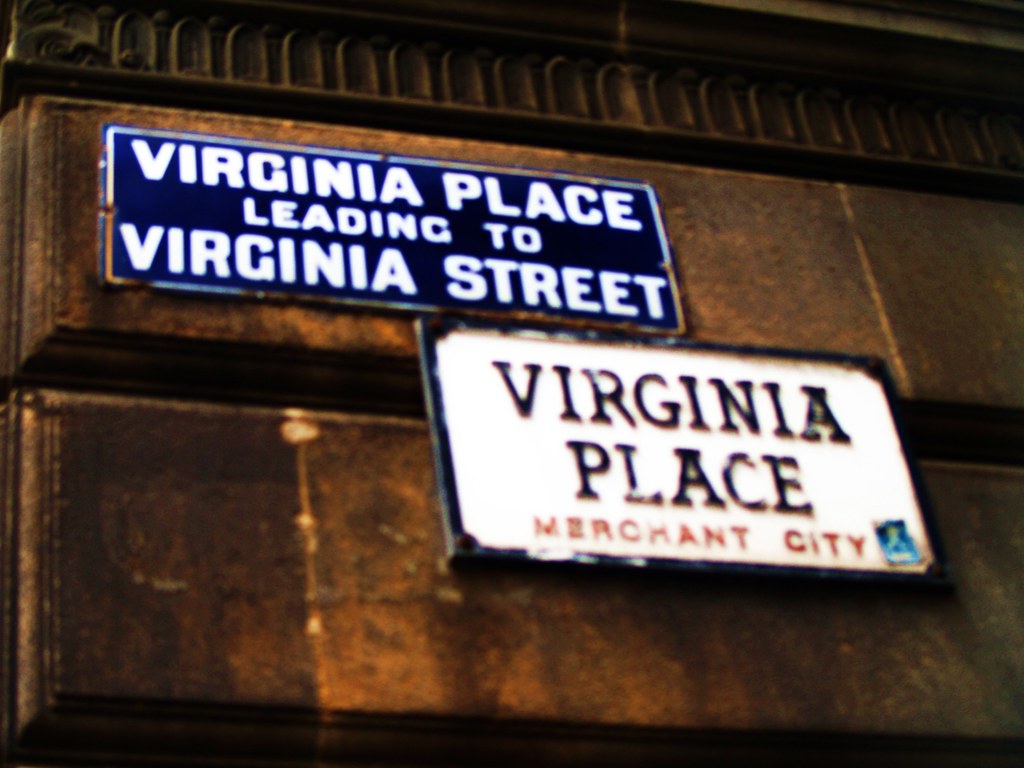
This lies at the heart of Glasgow’s City Centre. This is where the Tobacco Lords and traders came to do business, socialise and build their townhouses and warehouses. This area still possesses a remarkable consistency of materials and rhythm. There remains a strong civic pride evidenced by buildings adorned with carved coats of arms The Merchant City became the scene of a remarkable public sector led renaissance during the 1980s.
Note particular street names:
- Virginia Street (Tobacco/Colony/State)
- Jamaica Street (Sugar)
- Glassford Street (John Glassford, a Tobacco Baron )
- Buchanan Street (Andrew Buchanan, member of family of Tobacco Barons)
- Dunlop Street (Colin Dunlop, Virginia Merchant and founding partner in the Ship Bank.)


More information
The publication Visitors Guide to Scotland includes sections on Scotland’s principal cities and industrial history. ISBN is 978-1-9161332-0-4. Also available via Kindle.