Introduction
This evening, I am reprising a geology themed tour of Edinburgh. This was a small group led by a professional geologist. Emphasis was on geological sites associated with Sir James Hutton (1726-1797), the founder of the modern science of geology.
Hutton was a wealthy and multi-talented individual whose life coincided with the Scottish Enlightenment. This was a period of intense intellectual activity covering many disciplines.
Information on the geology themed tour of Edinburgh
One of Hutton’s key interests was earth processes. His work laid the foundations for the modern science of geology. Hutton departed from religious and other doctrines. He suggested that the surface of the earth is constantly being eroded with products deposited in the sea. The resulting sediments being compressed, folded and uplifted as part of a cycle of erosion, sometimes aided by volcanic activity.
Edinburgh’s Salisbury Crags were one of the many areas in Scotland which Hutton used for research in supporting his theory.
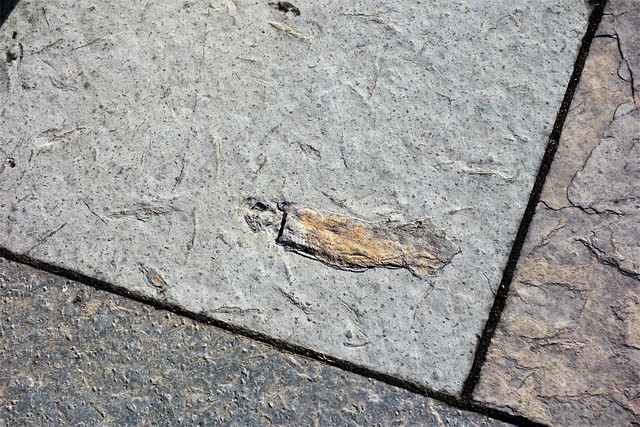
The tour commenced outside the Commonwealth Pool (public swimming pool). Here the pavement (sidewalk) outside is embedded a fossil lung fish from the Devonian period. This dates back 380m years and was quarried in Caithness, 250 miles north of Edinburgh. The fossil has nothing to do with Hutton.
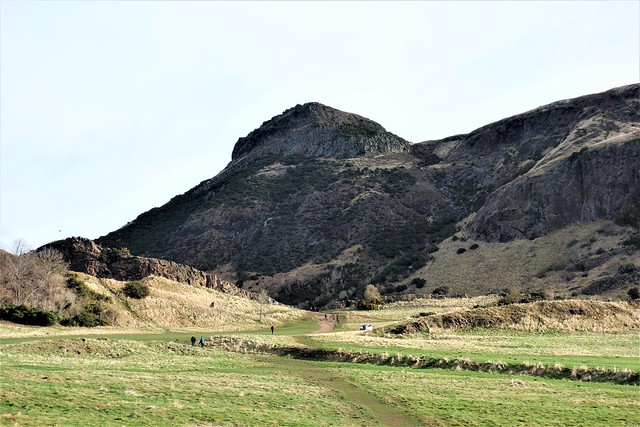
We walked over to Holyrood Park where Arthur’s Seat came into view. This is the base (agglomorate) of an ancient volcano dating back about 350m years.
Image below shows Arthur’s Seat. Relatively recent glaciation has carved out a cross-section which is of great help to scientists.
Images
Most of the time was spent at Salisbury Crags which stand out as a rough rock face on the Edinburgh skyline. The jagged surface is the result of 19th century quarrying. This is not a conventional volcano. It is the result of magma forcing its way through layers of strata resulting in a ‘sandwich’ effect.
Specimen of plagioclase feldspar at Salisbury Crags.

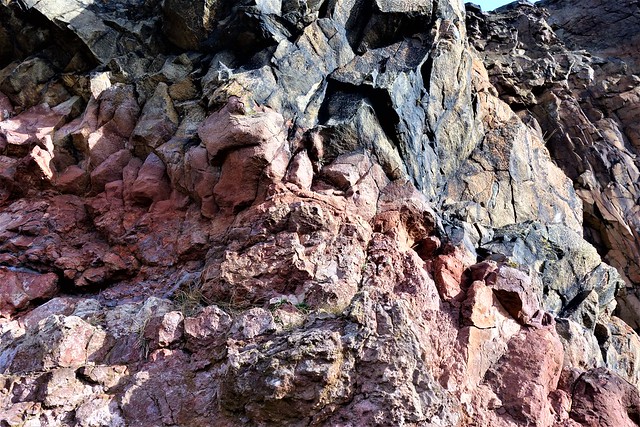
Image below illustrates a channel where slightly younger rock has forced its way into older rock.
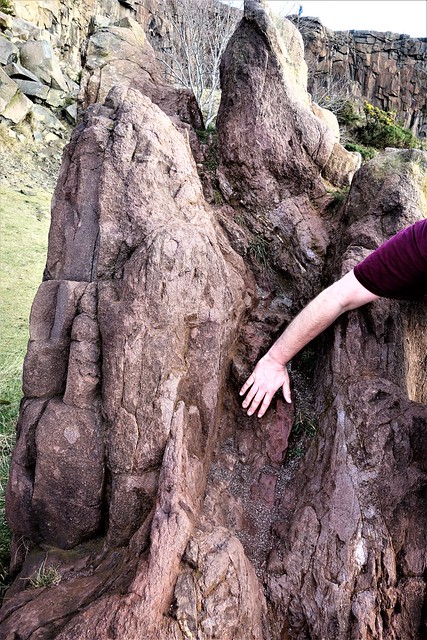
Image below shows infusion of basalt/dolerite below layers of sedimentary rock at top.This is the ‘sandwich’ effect adverted to above.
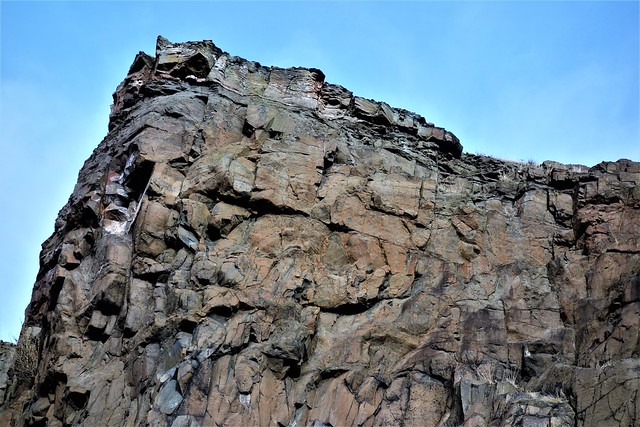
Image below shows layer of red sandstone (350m year old sedimentary rock) layered within basalt/dolerite rock.
At this low-level rock ‘wall’ in centre of image James Hutton demonstrated that local rocks had been formed from hot, molten material.
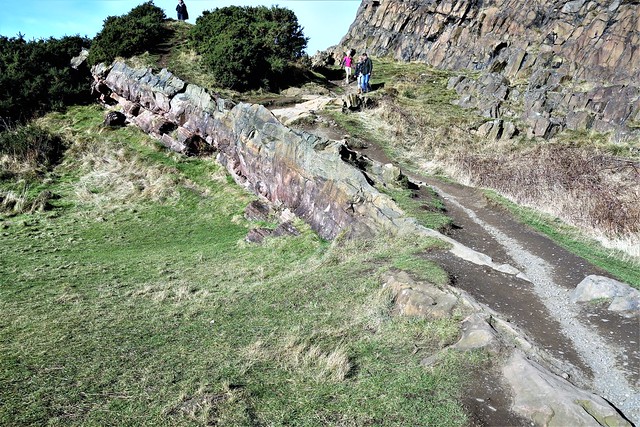
Image below illustrates where (dark coloured) magma has forced its way into the underlying sedimentary strata (light colour).
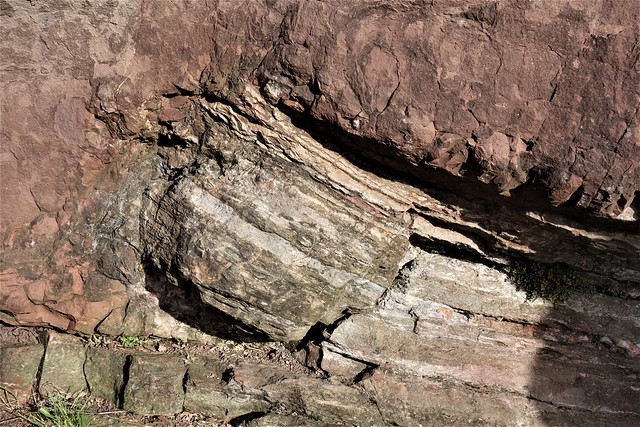
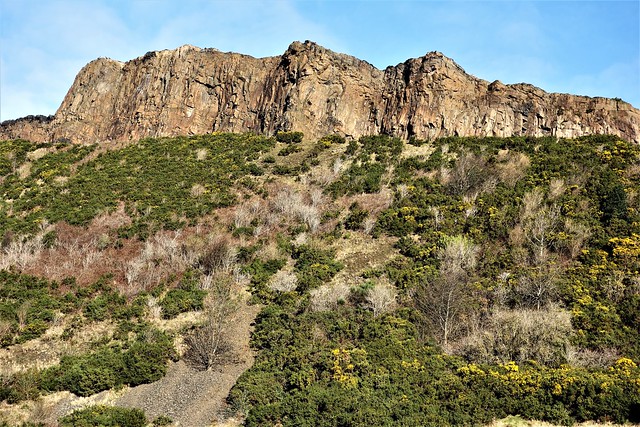
Image of Salisbury Crags.
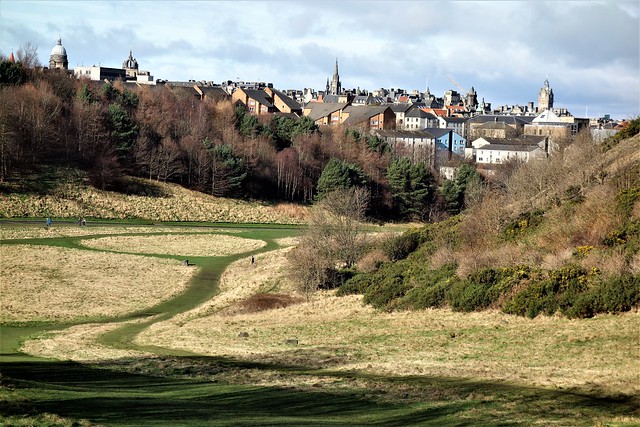
View of Edinburgh from Holyrood Park.
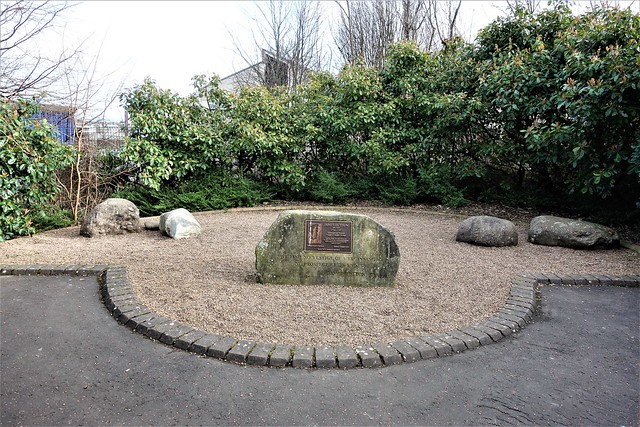
James Hutton Memorial Garden
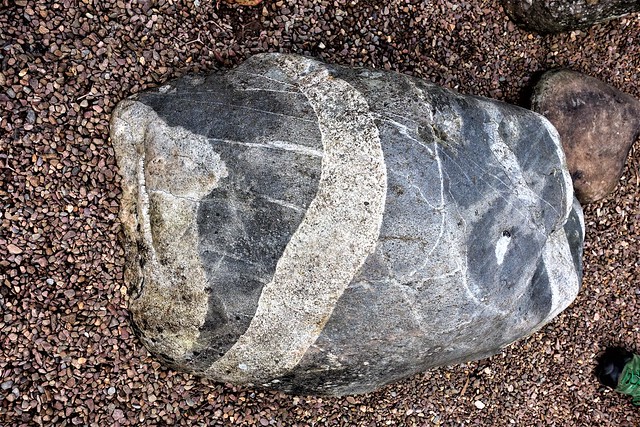
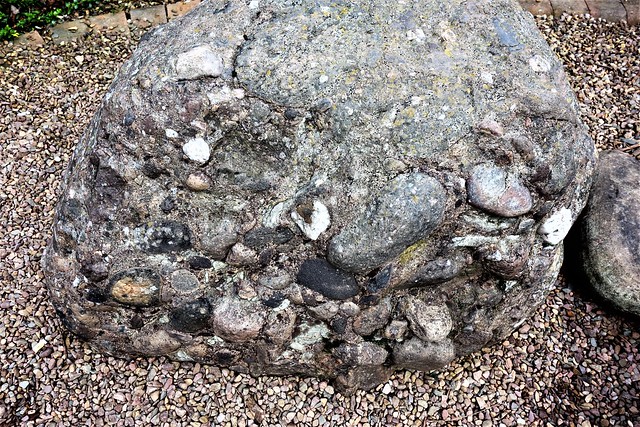
Image below shows the James Hutton Memorial Garden. This is located on the site of Hutton’s Edinburgh home on St John’s Hill in the Pleasance above Holyrood Park. The second image shows granite veins penetrating the country rock. The third image shows a boulder which is full of fragments of pre-existing rocks from a previous cycle of erosion.
Hutton’s Unconformity
Here is a link to a post covering Lochranza on the Isle of Arran. This includes a section on a geological feature known as Hutton’s Unconformity.
More Information.
The publication Visitors’ Guide to Scotland incorporates a section on Scotland’s fascinating geology. ISBN is 978-1-9161332-0-4. Also available via Kindle.