Introduction
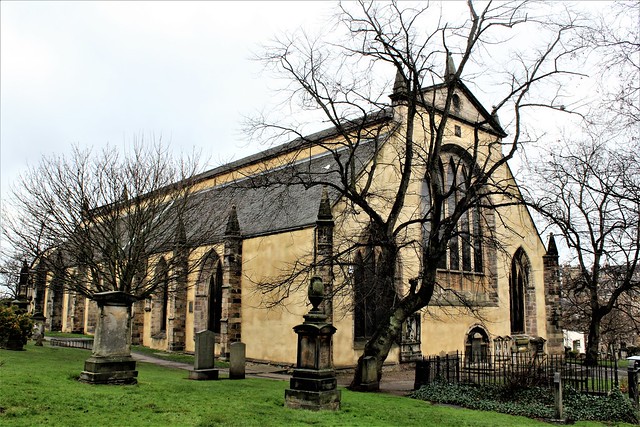
This evening I am following on a report that Edinburgh’s famous Greyfriars Kirkyard has become overwhelmed by tourists. Greyfriars Kirk is located on the southern edge of Edinburgh’s Old Town.
East end of Greyfriars Kirk, Edinburgh

Information on Greyfriars Overcrowding
The underlying problem centres on tourists wishing to connect with the Harry Potter stories. In particular, there is a grave marker recording the death of one Thomas Riddell on Nov 24th, 1806. It is believed that J.K. Rowling used “Tom Riddle” as the birth name of Voldemort, Harry Potter’s arch villain.Incredibly, this headstone now has it’s own location marker on Google Maps.
The Riddell tombstone along with some other perceived graveyard inspirations for the Harry Potter series has driven Greyfriars visitor numbers to record levels. In fact, Greyfriars Kirkyard now ranks as the third ranking free-to-enter visitor attraction in Scotland.The downside is that some of the approximate 2.0m visitors each year act irresponsibly. This results in unacceptable vandalism of what is a sacred burial site. The situation is aggravated by rogue tour guides with focus on exotic ghosts, ghouls and the like. Edinburgh Council can and does charge tour operators and guides a flat fee to enter the site but not individuals. Currently there is insufficient revenue to cover the repair and maintenance costs. Establishing pay to enter technology may conflict with Edinburgh’s World Heritage status.
Acknowledgement: The report above was sourced from the Times newspaper.
More information on Greyfriars Kirk
Greyfriars is a Presbyterian church located close to the site of a former Roman Catholic, Franciscan convent.This is from where the name ‘Grey Friars’ emanates.
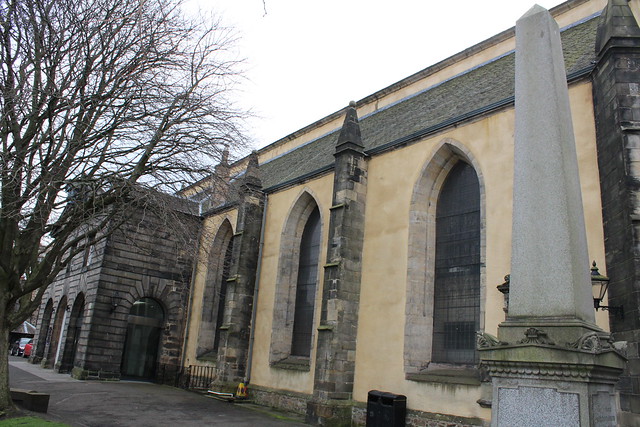
Northern entrance to Greyfriars Kirk.

The origins of the church date to 1562 when Mary, Queen of Scots granted land for burials. Subsequent events summarised as follows:
- Construction of the church had commenced by 1602 using stone recycled from the former convent nearby.
- Church opened in 1620.
- In 1638 Scotland’s National Covenant, a very important document, was presented and signed in front of the pulpit. This concerned the governance of the (national) Church in Scotland.
- Used as a barracks by Cromwell’s forces during period 1650-1653.
- Various structural changes and embellishments were effected.
- The tower, used a gunpowder store, was accidentally blown up in 1718.
- A new church was added on the building’s western side in the 18th century resulting in two discrete congregations.
- The kirkyard was used to hold 1200 Covenanter prisoners in 1675 pending trail.
- Extensive fire damage in 1845.
- In the mid-19th century two radical innovations were introduced namely, musical accompaniment to singing and stained glass.
- The ‘Greyfriars Bobby‘ story gained momentum after 1872.
- In 1929 the hitherto separate congregations merged and dividing wall removed.
- In 1979 the Greyfriars congregation merged with the nearby Highland Tolbooth St John’s. Subsequently, services in Gaelic have been held on Sundays.
Southern aspect of Greyfriars Kirk, Edinburgh.

The Kirkyard holds the burial places of many famous Scotsmen, as shown in image below.

Listing of famous persons buried in Greyfriars Kirkyard, Edinburgh.

The Kirkyard is accessible throughout the year whilst the building interior is open between April and October.
More information.
The publication ‘Visitors’ Guide to Scotland’ provides a wide range on information for the tourist. Included is information on Edinburgh, Scotland’s history, historical figures and much more. ISBN is 978-1-9161332-0-4. Also available via Kindle.