Introduction
This post provides a summary of the Roman occupation of Britain.
Reenactment Roman soldiers on Hadrian’s Wall

Information on Roman Britain- Part 1
In AD 43 a force comprising some 45,000-50,000 men comprising four legions successfully invaded what is now Southern England. The force comprised II Augusta, IX Hispana, XIV Gemina and XX Valeria This event was the precursor to the Roman domination of mainland Britain which lasted until AD 410. Overall, Britain was subject to Roman influence for a period of some 450 years. Despite the long period of time, Britain was always at the edge of Roman influence. The province never achieved the wealth, status and sophistication of countries at the heart of the Empire. However, in Britain the Romans left a massive physical legacy as manifested in roads, towns, cities, villas and palaces. There are also hoards of coins and valuables and engineering feats that we can still appreciate today.
Artist’s impression of Roman Fort at Doncaster

Towns in Roman Britain: Londinium (London), Durovernum (Canterbury), Verulamium (St. Albans), Camulodunum ( Colchester), Venta Icinorum (Norwich), Calleva (Silchester), Regnum (Chichester), Venta Belgarum (Winchester), Sorbiodunum (Old Sarum), Durnovaria (Dorchester), Isca Dumnuniorum (Exeter), Aqua Sulis (Bath), Corinium (Cirencester), Clevum ( Gloucester), Venta Silurum ( Caerwent), Isca Augusta (Caerleon), Magnae (Kenchester), Virconium (Wroxeter), Ratae (Leicester), Durobrivae (Castor), Lindum ( Lincoln), Deva (Chester), Eburacum ( York), Isurum ( Aldborough), Luguvallium ( Carlisle), Corstopitum (Corbridge). Most of these towns were under civilian control.
Information on Roman Britain- Part 2
Industry in Roman Britain: This was the iron-age with Britain essentially an agrarian society. Key manufacturing industries were:
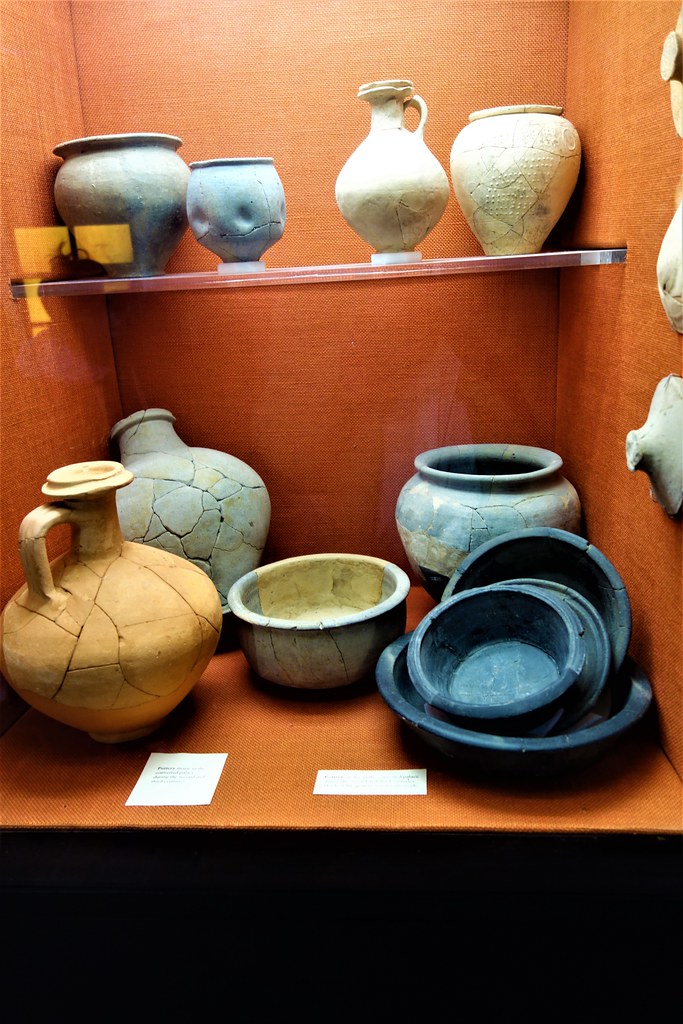
- Pottery manufacture in the Nene Valley , Medway and New Forest.
- Glass-working in N.E. England.
- Bronze and silver brooches.
- Enamelling.
Roman pottery as Fishbourne Palace
Roman Military Remains: There is a considerable legacy of camps, forts, walls, legionary centres (e.g. York, Chester, and Caerleon). Additionally,there are the World Heritage sites comprising Hadrian’s Wall and the Antonine Wall. In Perthshire (Scotland) can be found an early Roman frontier known as the Findo Gask Ridge.
Roman Villas: In the main these were undefended grand country houses occupied by local Britons who had become romanised. These properties are mainly found in Southern England reflecting the wealth derived from the fertile farming lands. The principal sites are: Bignor, Chedworth, Fishbourne Palace, North Leigh and Lullingstone.
Artist’s impression of North Leigh villa

Information on Roman Britain- Part 3
Public Buildings and Baths: The forum in each town was a combination of market-place and civil administration.Examples have been excavated at Silchester and Caerwent. Amphitheatres (for public entertainment) have been found at Dorchester, Caerleon, Richborough, Silchester and Cirencester. Bathing was an integral part of everyday life for the wealthier section of the community. Roman Baths are similar to modern-day Turkish baths and essentially comprise a three stage process.This comprises the frigidarium (cool room), tepidarium (warm room) and caldarium (hot room). The skin was scraped as soap was not available. Key example is the famous baths at Bath (Aqua Sulis) However, bathing facilities were widespread encompassing military establishments and civilian residences such as villas.
Model of bathing complex at Bath

Roman Coins: Britain participated in the monetary system of the Western Roman Empire. Most coins in circulation were struck in mints on continental Europe. The most common coins discovered feature the important emperors.Included are Constantine, Gallienus, Claudius Gothicus, Carausius and Constans, Vespasian, Trajan, Hadrian, Antoninus Pius and Faustina I. Hoards of Roman coins continue to be discovered.
Roman Roads: It is estimated that the Romans built some 10,000 miles (16,000km) of roads This network still forms the skeleton of Britain’s road system. In the early years of the occupation the roads were probably built by military engineers to a very high standard.However, standards subsequently slipped as the communications emphasis switched to commercial and agricultural needs.
Remains of road at Vindolanda, Hadrian’s Wall

Connect with Roman Britain through Re-enactment
Here is a clip of a re-enactment tour along Hadrian’s Wall arranged by the writer.
More information for the visitor.
Information on Hadrian’s Wall, the Antonine Wall and Scotland’s history can be found in Visitors’ Guide to Scotland. The ISBN is 978-1-9161332-0-4. This is also available via Kindle.