
Introduction
Yesterday, I visited an excellent exhibition on Roman Army Life titled ‘Legion life in the Roman Army’ at London’s British Museum.
Information on the Exhibition of Roman Army Life-Part 1
The Roman Army existed for an incredible length of time of about 2205 years, from 753 BC to 1453 AD. Manpower fluctuated but is believed to have totalled around 350,000 divided into 28 legions.
Recruits had only a 50pct chance of surviving until retirement (due to military action or disease). Despite these factors a military career was a well paid and popular career with young men from all around the Empire. A key attraction was the carrot of a lump sum payment equivalent of 10 times annual pay.This gratuity would have underwritten a comfortable retirement. Auxiliary soldiers were granted full Roman citizenship at end of 25 years service.
Here is a tombstone of father and son, both named Ares, both have whom had undertaken military service.The younger Ares died age 29 years on happening of which the legionary shield was returned to his father.
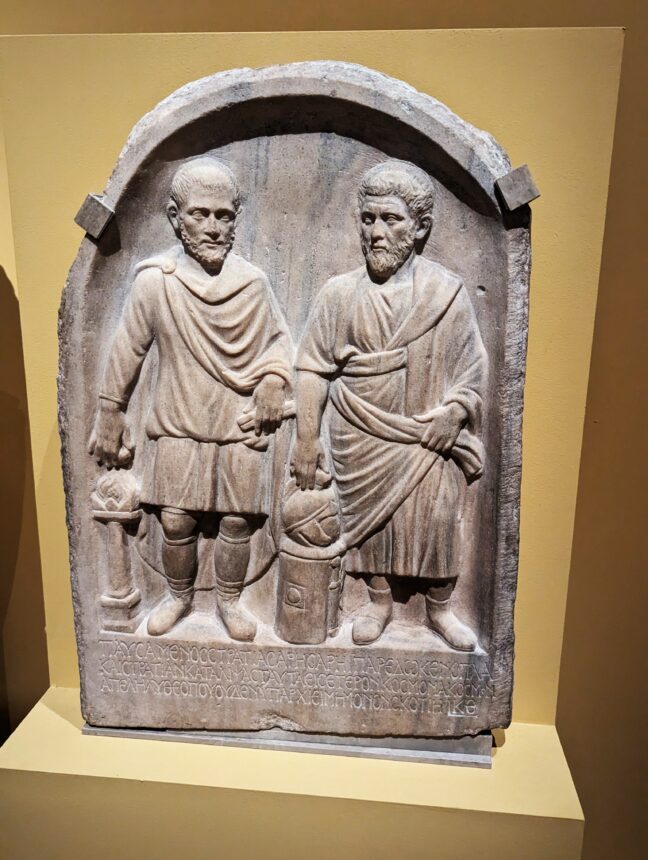
In AD 212 the emperor Caracalla granted all free inhabitants of the empire full Roman citizenship. One of the drivers of this edict may have to enlarge the recruitment pool for legionaries.
Information on the Exhibition of Roman Army Life-Part 2
Image below shows the world’s most complete Roman legionary’s articulated cuirass. This was found at the site of the Battle of Teutoborg Forest in Germany. Here the Romans suffered a crushing defeat in AD 9.
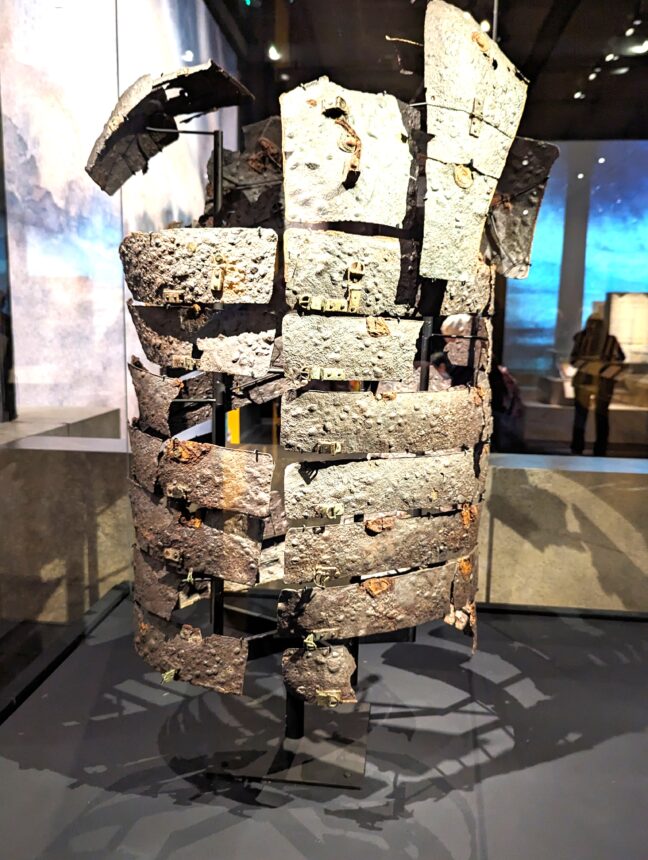
The vessel below was used by the Romans to swindle suppliers of grain.The inscription says it holds 17.5 sextarii but in reality it held 20.8 sextarii.

Information on the Exhibition of Roman Army Life-Part 3
The Roman military forces totalling approximately 350,000 were used to police a state of over 60 million. Retribution meted out by the military was harsh with beatings and executions commonplace.
Image below shows gaming counters. Warm bathhouses were a favourite place for off-duty soldiers to relax and socialise.
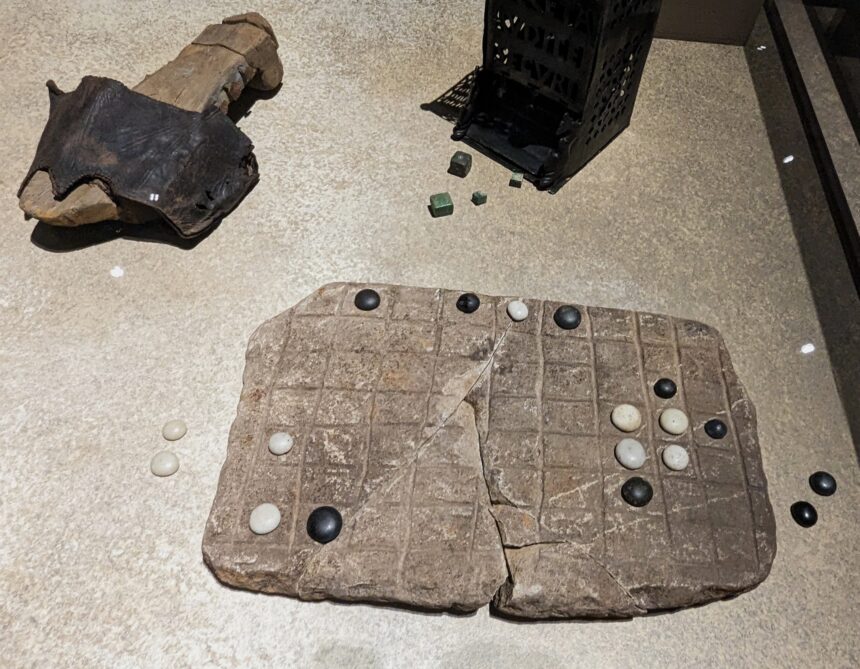
There is evidence that wives were allowed to accompany their senior officer husbands in frontier postings.The tombstone below was found in modern-day Carlisle which evolved from a Roman settlement close to Hadrian’s Wall in northern England. The woman may well have been an officer’s wife being depicted in genteel poise with an elegant fan. However, the latter item would rarely be required in the climate of NW Britain.

These thin slivers of wood rank as one of Britain’s top historic treasures.They were found at the Roman fort of Vindolanda,close to Hadrian’s Wall and are covered in a Latin based script. Fortunately,a large number of these every-day communications from the 1st/2nd centuries AD were preserved in water-logged conditions. They provide a wonderful insight into both military and domestic matters of the time.
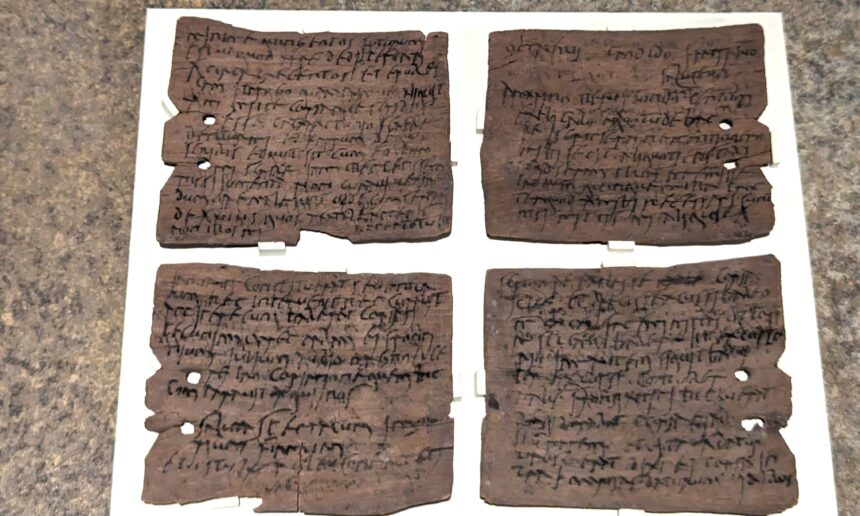
Seemingly, the Romans held one years’ worth of supplies for military forts. The wooden barrel below, with a central bunghole, was found on the (2nd century AD) Antonine Wall in Scotland. It is inscribed by scratching with the name of the owner or vendor, one Januarius.
Information on the Exhibition of Roman Army Life-Part 4
The Romans were known to have high standards of medical care. They had treatments for contagious eye ailments which were common in the cramped barracks. There was a vinegar salve for running eyes, drops for dim sight, poppy salve and a mixture for clear sight.
Here is an image of horse armour made from iron, linen and leather.

At commencement of combat Roman legionaries fought with short sword and pilum (javelin).
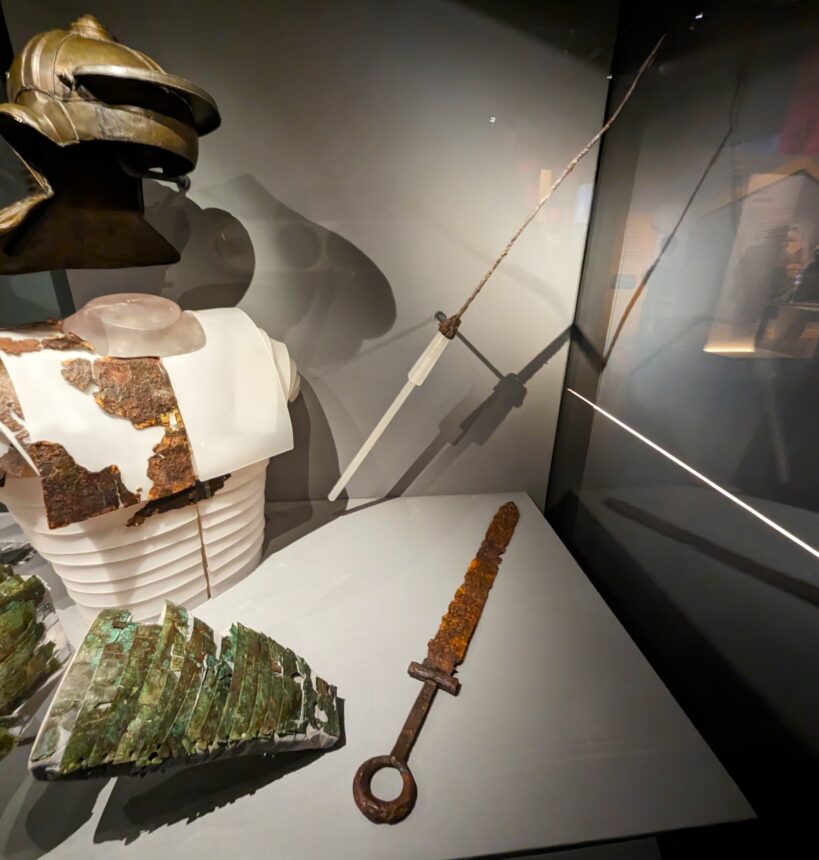
The magnificently preserved helmet below shows the most developed protective features of Roman military headgear.

Information on the Exhibition of Roman Army Life-Part 5
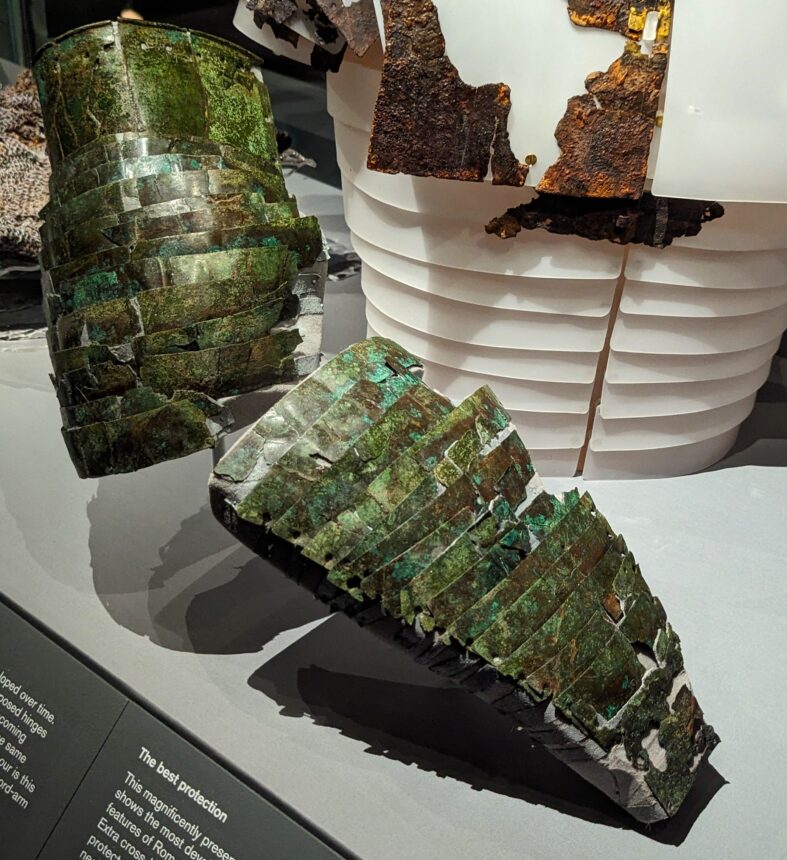
This example of sword-arm protection has been designed with minimal exposed hinges to avoid damage during battle. Similar to armoured sleeves worn by gladiators. Found at Trimontium fort, Newsteads, Scottish Borders.
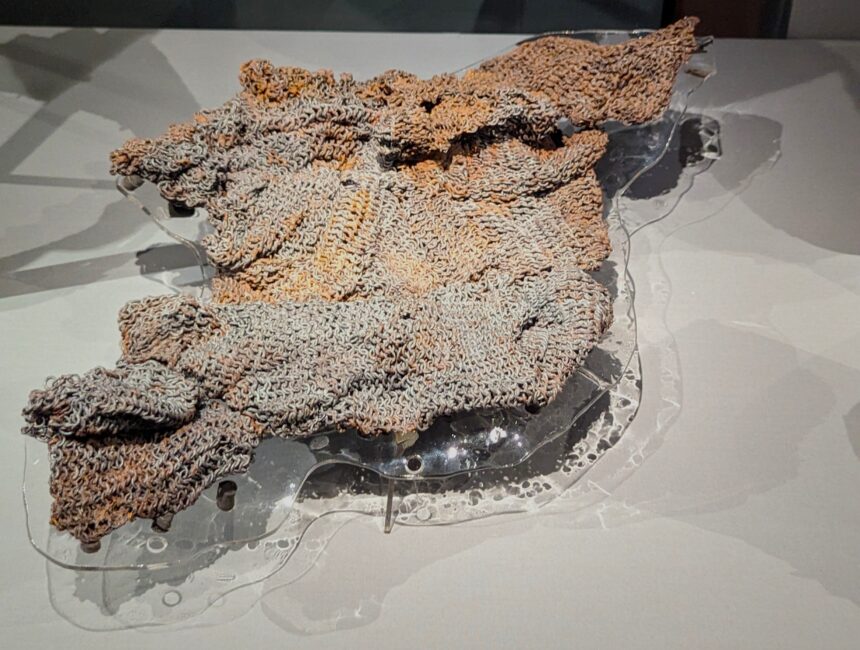
Here is a chainmail shirt found at Arbeia fort on Hadrian’s Wall. IT may have belonged to a soldier of the 5th cohort of Gauls. Manufacture of the item would require painstaking skills and be very expensive to produce.
During Roman times Crocodiles were worshipped in Eqypt. The tough leather of the crocodile may have provided adequate protection for some soldiers. Alternatively, the skin may have been worn under metal armour for cushioning, adding flexible hip and shoulder protection.


Helmets

Side Arms
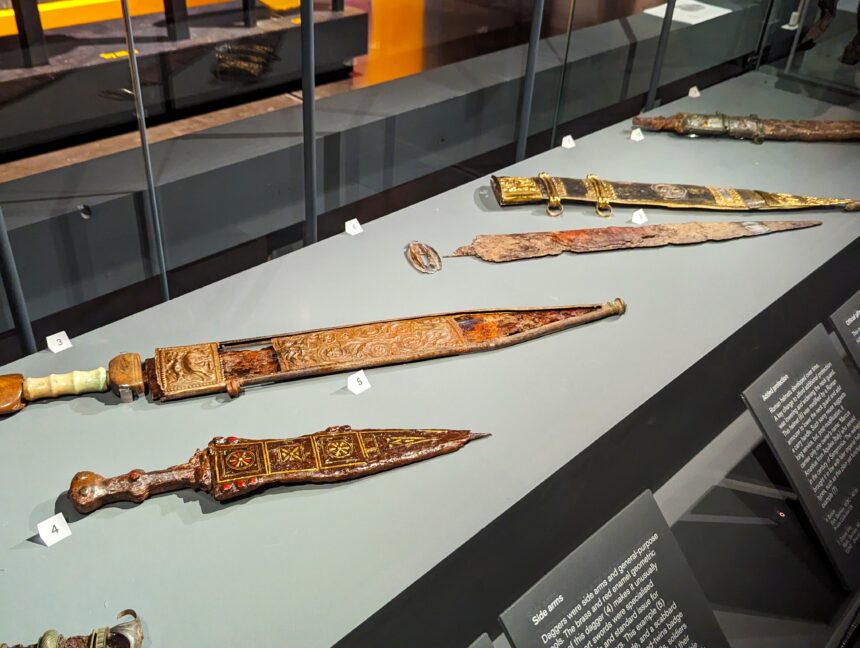
Military Metalsmiths

Defend and Attack
The central boss from a legionary shield protected the user’s hand and provided a punching weapon.

Below is an image of the complete surviving Roman legionary long shield (scutum). It comes from Rome’s Syrian frontier where the dry climate preserved the wood and its remarkable painted leather surface.

Information on the Exhibition of Roman Army Life-Part 6
Dressing for battle
Soldiers had to buy their own arms and armour. They could make new or second hand purchases from fort armouries or, sometimes, from local craftsmen.. There was no specific uniform beyond a military belt.

Draco-the dragon standard.
By the AD 100s this distinctive windsock-like standard, especially suited to being wielded from the saddle had been adopted from Rome’s Sarmatian (nomadic Iranian) foes-the draco. This bronze standrad head had a tube of colourful materials attached. The material trailed behind the rider, blown by the breeze, and emitted a whistling sound to suggest the fearsome beast’s howl.

This enormous tombstone memorialises cavalryman Titus Flavius Bassus as he tramples a ‘barbarian.His enslaved groom follows with spare spears.

Information on the Exhibition of Roman Army Life-Part 7
Cavalry
Cavalrymen formed an elite cadre of the legion. They received extra pay for owning a horse and its equipment which could be maintained by an enslaved groom.
Centurions
Image below shows a memorial to Marcus Caelius, a high ranking and highly decorated centurion of the 18th legion who died age 53 years.He earned 30 times an ordinary legionary’s wages.

An ordinary soldier could aspire to become a centurion earning 15 times more pay and commanding a century of eighty or more men.
Instruments of War
Trumpeters relayed the centurion’s orders over the din of marching and battle. Cornicines played the most important instrument-a long, curled horn called a cornu. Starts and stops were signalled by a shorter straight horn, or tuba.

Loyalty and imperial worship
Emperor worship was a cornerstone of the Roman Empire. Special standard bearers proudly carried the image of the emperor into battle. However, mutinous troops might tear down the imperial image in a show of defiance, as happened to emperor Galba (ruled AD 68-9). The battered silver bust below of Galba once topped a pole.

Standard bearers
Standard bearers earned double the pay of ordinary soldiers. In return they had to be numerate to keep the men’s pay accounts and brave enough to lead the troops into battle. Each century had its own standard.

Ranks and pay in the Roman army.

Information on the Exhibition of Roman Army Life-Part 8
Roman Roads
The empire’s network of roads connected lands, peoples and military outposts. Travel was an essential part of soldiering. Troops faced hard labour building and maintaining roads. The milestone below declares ‘eight miles to Kanovium’ (Conway in N. Wales.)

Footwear
Hobnailed sandal, AD 43-410. Found in London, England

Hobnailed boot, c AD 100-5. Found at Vindolanda, England.

Auxiliaries
These were the regiments intended for non-citizen troops to support the citizen legions.Image below shows Firmus Ecconis who died age 36 while serving as an auxiliary foot soldier armed with a simple thrusting spear and oval shield. He earned less than a legionary but still flaunts his accumulated wealth with the impressive tombstoine featuring Fuscus the enslaved child (left) and Firmus’ son (right). Retiring auxiliaries were rewarded with a grant of Roman citizenship.

More information can be found in the publication ‘Legion life in the Roman Army’ by Richard Abdy. ISBN 978-0-7141-2294-6.
More information for the visitor.
Information on Hadrian’s Wall, the Antonine Wall and Scotland’s history can be found in Visitors’ Guide to Scotland. The ISBN is 978-1-9161332-0-4. This is also available via Kindle.