Introduction
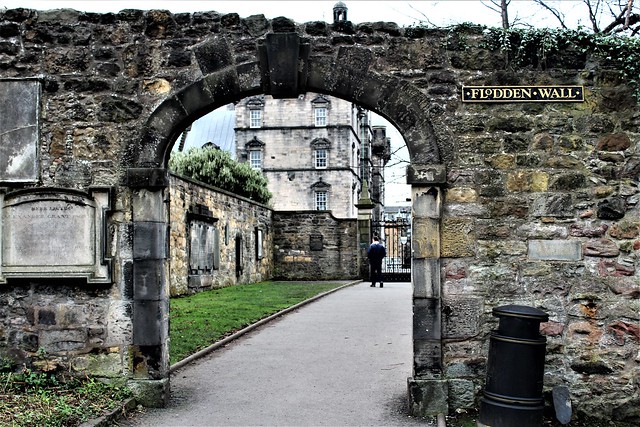
This evening, I am posting information on Flodden Wall in Edinburgh, a de facto memorial to a major military defeat. This was the Battle of Flodden (1513) which resulted in a Scots defeat and death of up to 17,000 men.
Events leading up to the battle
In the 16th century Scotland and France had a mutual defence pact which was chiefly aimed at England.
In May 1513 King Henry VIII invaded France, an act which triggered a response from Scotland.
The French supplied money, arms and military personnel to assist the Scots.
As a consequence of Henry’s rejection of an ultimatum to withdraw from France a large Scots army marched into England. This is estimated to to have comprised 60,000 men.
Henry had anticipated the Scots invasion. In response he sent a force under the experienced general known as the Earl of Surrey. The English force, which totalled about 26,000 men, headed to Alnwick in Northumberland about 86 miles S.E.of Edinburgh. Alnwick was reached on Sept 4th 1513.
The Battle
The Scots army, under King James IV was positioned on 500-600 feet high feature known as Flodden Edge.
On 8th of September Surrey positioned his force north of the Scots thus cutting off the Scots line of retreat. On September 9th the Scots marched a mile to Branxton Hill, a less daunting vantage point.
Outcome of the battle was determined by choice of weaponry and the terrain. The Scots used massed pike formations whereas the English used a combination of bow and bill. A bill was a combination of spear and axe.The hilly terrain became slippery and slowed the Scots attacks. Moreover the pike was effective in battles of movement which Flodden was not.

Casualties on the English side amounted to about 1500 whereas the Scots lost between 10,000 and 17,000.

Reperccussions of the battle
The death toll on the Scots side impacted across society. The king was killed on the battlefield. Other casualties included an archbishop, earls, barons, 300 knights plus the cream of Scottish manhood. This major loss was felt across the land.
The king’s death meant a minor noble ascended the throne causing a new era of political instability for Scotland.
The Scottish remember the Battle of Flodden today with the haunting ballad and pipe tune “The Flowers of the Forest”. This was written 300 years after Flodden, the lyrics are written to commemorate the fallen Scots.

Flodden Wall
The Wall is reputed to have been constructed by women and children after the defeat at Flodden. This was a measure to protect the important medieval city of Edinburgh. Female and child labour is attributed to shortage of males following the catastrophe at the Battle of Flodden.There is evidence to suggest that Flodden was not a new wall but a rebuild of an existing wall. This type of wall would not have been impervious to a concerted military attack. Instead serving key purpose as a boundary, controlling flow of goods, facilitating taxation and deterring smuggling.
By the 18th century the Flodden and other walls had become obsolete and parts were demolished.
Images in this post show remaining sections of the wall at Greyfriars Kirk and Drummond Street.

More information for tourists
The publication Visitors’ Guide to Scotland contains sections on battles, Edinburgh and a wide range of other topics. ISBN is 978-1-9161332-0-4. Also available via Kindle.