Introduction
This evening, I am focusing on the Roman Bath-House at Bearsden, about six miles north of Glasgow.. This was discovered as recently as 1973. Location is on the appropriately named Roman Road. This follows the line of the Roman Military Way, a communication line for the Antonine Wall.
Information on the Bath-House
This structure was an annexe attached to the Roman Fort. This was one of, possibly, twenty-six such forts which formed an integral part of the Antonine Wall. The Wall was commissioned in 142 AD by the Roman Emperor Antoninus Pius. For approximately twenty years this boundary was a military zone which formed the northern frontier of the Roman Empire.
More information
Attached to the rear of the Wall and was made of turf on a stone base.
The complex included barrack blocks, stables, storehouses, workshop and granaries
This fort was of modest size compared to some other forts along the Wall. It may have been the base for just a detachment of troops, possibly from the Fourth Cohort of Gauls. This was a mixed cavalry and infantry unit.
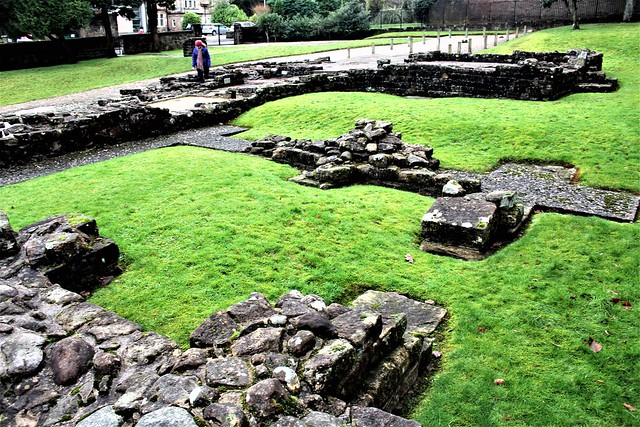
- The fort was built of timber and stone. Latter material used for the heated rooms to minimise the risk of fire.
- Walls were plastered on the inside with roof of thatch or shingle. Latrines were thatched.
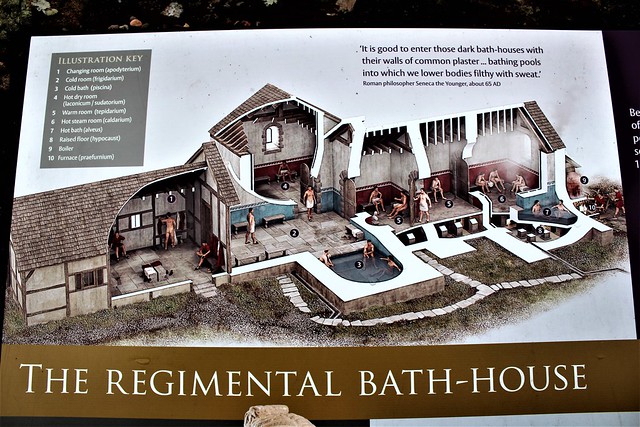
- The bather would enter a timber changing room then continue into a cold room. Next, he could move into a hot, dry room (caldarium) or continue into a steam range. The floor of the hot room was heated to such a temperature that sandals would be needed. The steam range contained three rooms of increasing warmth which were heated by hot air ducts under the raised floors.
- Passing through the various stages was a relaxed and quasi social event During the proces oils and a scraper (strigil) would be used to clean the skin. Soap was not available in Roman times.
- Finally, the bather would avail of a cold dip in the Frigidarium before dressing and returning to duty.
The bathing process is very similar to a modern-day Turkish Bath.
Video clip of the baths
Military Diet
Adjacent to the Bath-House is the latrine which could have sufficient for simultaneous use by nine soldiers. Analysis of the sewage at Bearsden has provided a very useful insight in to the diet and condition of Roman soldiers.Analysis suggests the soldiers were infested with both whipworm and roundworm. There is evidence of a varied diet. Such included wheat, barley, bean, fig, dill, coriander, opium poppy raspberry, bramble (blackberry), wild strawberry, bilberry, celery and hazelnut. Some of these food items may have been imported from the borders of the Mediterranean region.
Commercial Activity
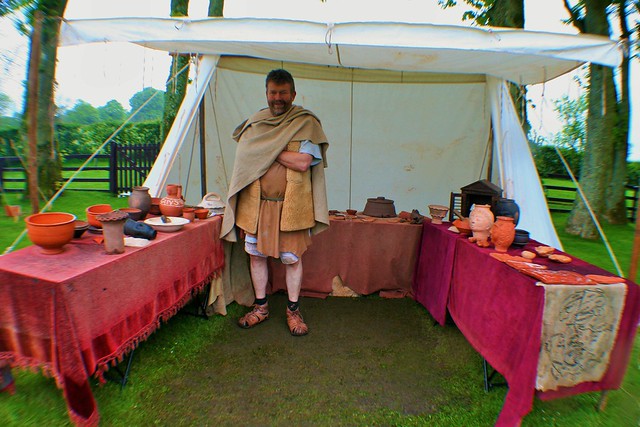
Pottery was used extensively during the Roman period. One potter named Sarrius appears to have established a workshop at Bearsden where many of his wares have been found. He also had workshops near modern-day Leicester and Doncaster both of which have Roman origins.
More information for the visitor
Overall, a fascinating site for students of the Roman period. Entrance is free and the site is open 24/7.
The publication Visitors’ Guide to Scotland contains information on the Antonine Wall and Hadrian’s Wall plus much more. The ISBN is 978-1-9161332-0-4. Also available via Kindle.