
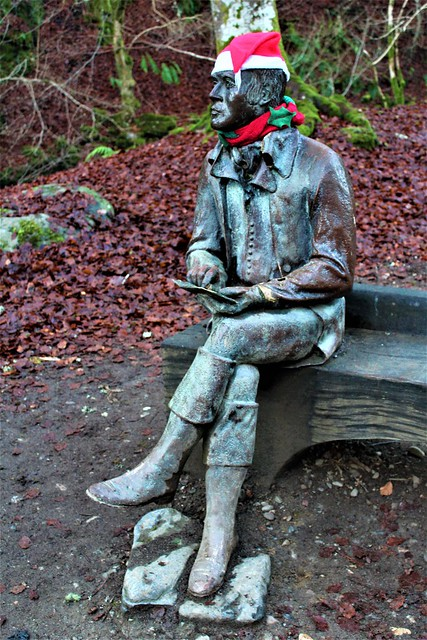
Seasonally affected Robert Burns
Introduction
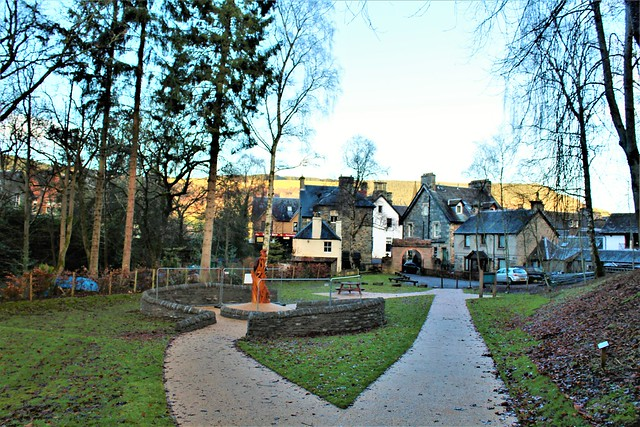
Tonight, I am reprising a seasonal hike around the Birks of Aberfeldy in central Scotland. Location is about seventy miles north of Glasgow, close to Kenmore and Loch Tay.
More information on the Birks of Aberfeldy
Before moving on into detail here are some key rehearsals covering names:
- Birk=Scots word for birch.
- Aberfeldy: Aber is a Brittonic (Welsh) word for ‘meeting of the waters’. ‘Feldy’ is derived from peallaidh, the name of a local water-sprite. This name may date back 1500-2000 years. Today, Aberfeldy is a small town in central Scotland, popular with tourists.
- Burn = Scots word for stream or small river.
- Moness: This a Gaelic word meaning ‘At foot of the waterfall’.
Interestingly, the above names reflect Scotland’s linguistic mix of Brittonic (Welsh), Scots-English and Gaelic.

Moness Burn
To hike the route entails traversing a circular trail of 2.15 miles around steep gorge through which flows the Moness Burn. The route is enhanced with multiple waterfalls and reaches a height of 656 feet.

Frothing Waterfall
Apart from its natural beauty the site has achieved fame through connection with Scotland’s National Poet who visited the Birks in 1787 and was inspired to write a song lyric The ‘Birks of Aberfeldy’ for pre-existing melody an extract from which is: “Now simmer blinks flowery braes:And o’er the crystal streamlet plays: Come let us spend the lightsome days, On the Birks of Aberfeldy.”


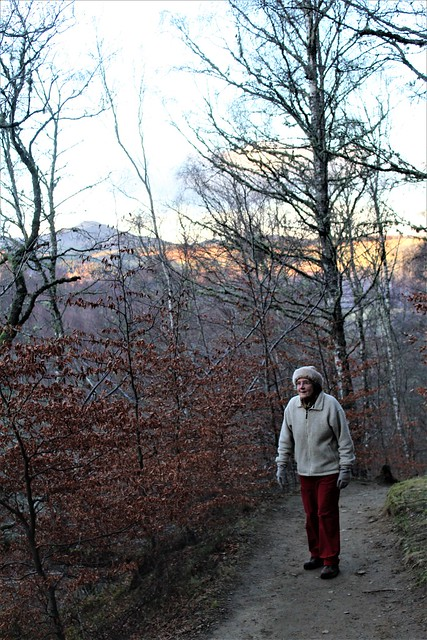
Intrepid hiker with Schiehallion (3554 ft) in distance.
Our hike lasted about 75 minutes and entailed some good views of the wider landscape.


Cave where-allegedly- Robert Burns wrote his poem ‘The Birks of Aberfeldy’.


Waterfall
More information for the visitor
The publication Visitors’ Guide to Scotland spans nearly 800 pages and provides a wide range range of information and images including activities. ISBN is 978-1-9161332-0-4. Also available via Kindle.