Introduction
This afternoon I am reporting on a custom tour of Glasgow.This commenced with a pick-up at Bowfield Hotel & Country Club, Howwood, From there we drove for about thirty minutes into Glasgow.
Information on Custom Tour of Glasgow-Part 1
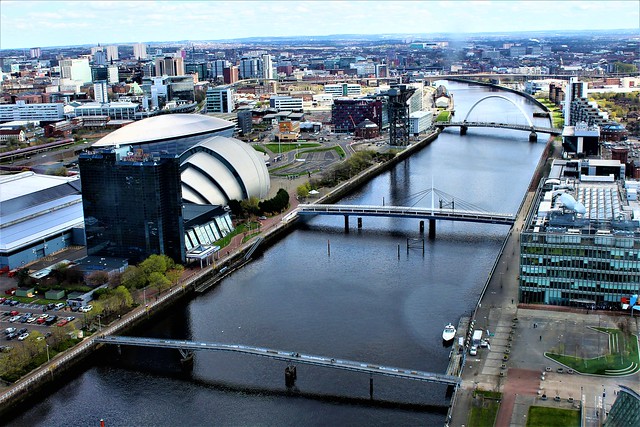
Glasgow and River Clyde looking east
First, I collected guest at Bowfield Hotel & Country Club, Howwood.Then to the National Piping Centre.

Bowfield Hotel & Country Club, Howwood
This is located in a former church dating from 1872. It is now a venue with rehearsal rooms and an auditorium to promote the study and history of Highland Bagpipes. There is a small museum attached. Various merchandise is available for purchase.Inside the main body of the building is stained glass.Purpose of the decorated glass is to portray classical bagpipe music.Emphasis is on. the formal yet poetic nature of classical pipe sound. Also to illustrate the complexity and multi-layered quality of this music.

National Piping Centre, Glasgow
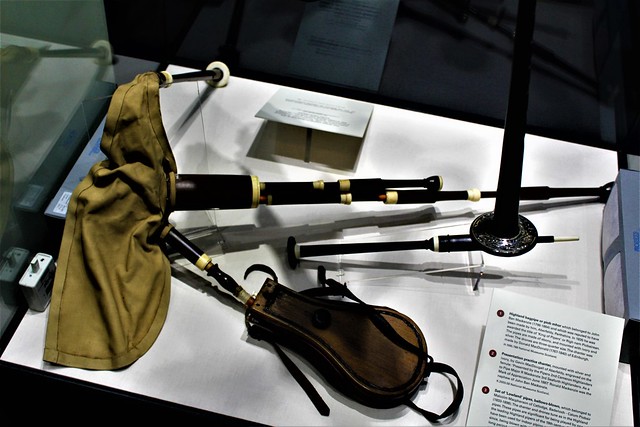
Museum Exhibit
This was the work of famous Glasgow architect, Charles Rennie Mackintosh (1868-1928) and his wife, Margaret MacDonald. Design dates from 1901 but the building was not completed until 1996.

Dining Room at House for an Art Lover

House for an Art Lover, Glasgow
This was also the work of Charles Rennie Mackintosh. It was constructed between 1903 and 1906 and proved to be Mackintosh’s last public commission in Glasgow. The School is now a museum.

Conical Tower at Scotland Street School, Glasgow.

Scotland Street School, Glasgow
This is located on the south bank of the River Clyde near the centre of Glasgow. Exhibits and attractions are orientated towards young students. Within the same complex is the 417 foot high Glasgow Tower. The viewing platform on top is reached by fast lift/elevator.

View west from atop the Glasgow Tower.

View north from atop the Glasgow Tower
Information on Custom Tour of Glasgow-Part 2
About ten minutes drive from Science Centre is Govan Old Church. Here can be seen a unique collection of sculptured stones from the 9th, 10th and 11th centuries. All of the carvings usedl locally quarried sandstone. They point to the importance of the Govan site and reflect a merging of culture. These cultures include Pictish, Irish, Cumbrian and Scandinavian.

Early medieval sarcophagus.

Hogback gravemarkers at Govan Old Church
Finally, guest was transferred to hotel at Glasgow Airport in readiness for early morning flight next day.
More Information
For more information on Scotland, it’s cities and much more please refer to the Visitors’ Guide to Scotland, ISBN 978-1-9161332-0-4. This book is also available via Kindle.